The Jet Age Begins: From the Me 262 to the F-86 Sabre
The transition from piston engines to jet propulsion was not a single moment but a cascade of breakthroughs, wartime desperation, and post-war rivalry that fundamentally rewrote the rules of aerial combat within a single decade.
Introduction
On August 27, 1939, four days before Germany invaded Poland, a small turbojet-powered aircraft lifted off from Marienehe airfield near Rostock. The Heinkel He 178, piloted by Erich Warsitz, became the first jet-powered aircraft to fly. The flight lasted just minutes. The aircraft was unstable, underpowered, and militarily useless. But it proved a principle that would reshape aviation forever.
The Pioneers
Two men, working independently and unknown to each other, invented the jet engine. In England, Frank Whittle, a young RAF officer, filed his first patent for a turbojet in 1930. In Germany, Hans von Ohain began his own work in 1935 at the University of Gottingen. Von Ohain, backed by the Heinkel company, reached flight first. Whittle's engine powered the Gloster E.28/39 on May 15, 1941, nearly two years later.
Whittle's story is one of institutional indifference. The Air Ministry showed little interest in his patent, and he struggled for years to secure funding. The patent lapsed in 1935 because Whittle could not afford the five-pound renewal fee. By the time British officialdom recognized the jet engine's potential, Germany had a substantial lead.
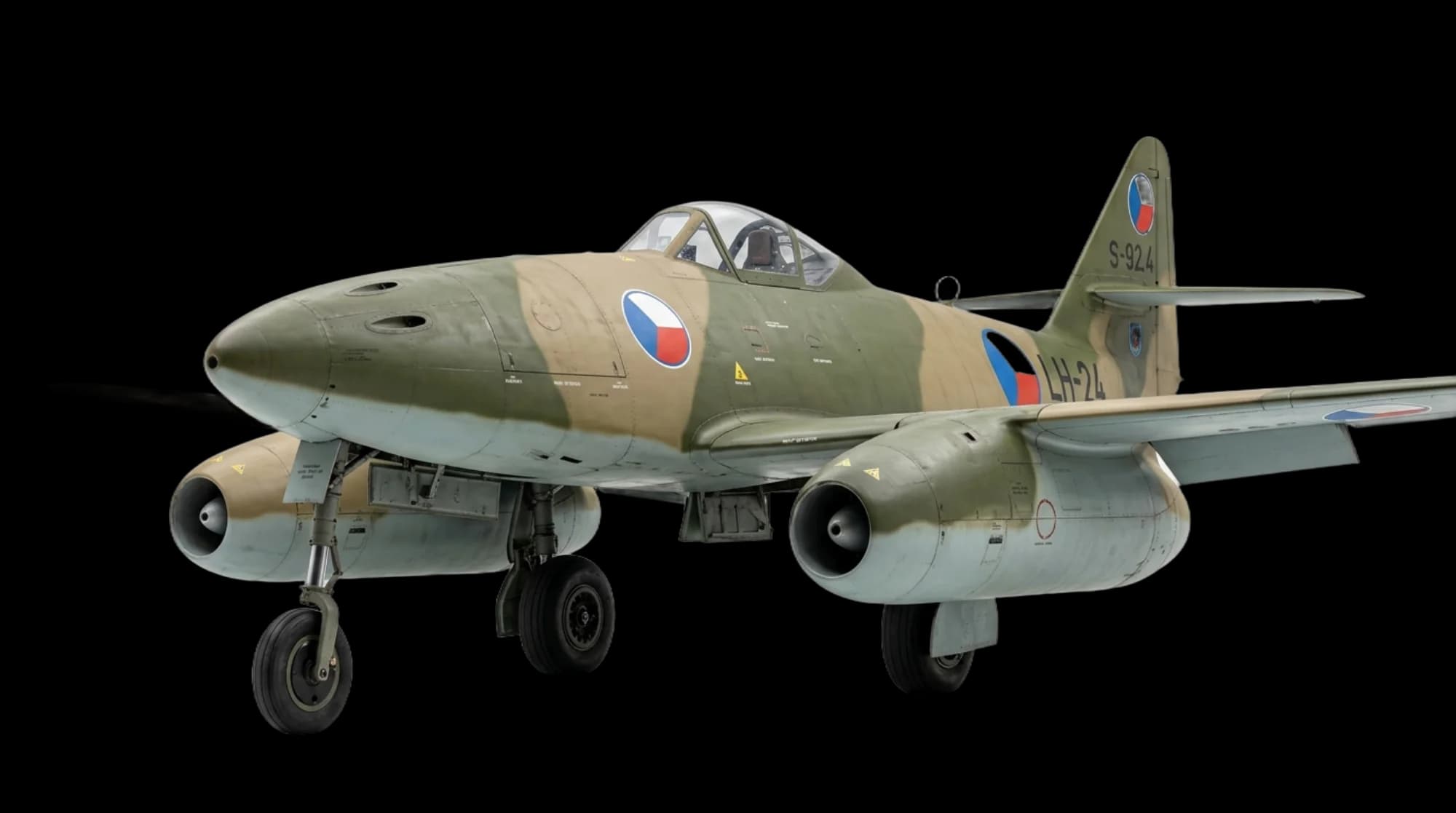
The Messerschmitt Me 262
The world's first operational jet fighter, the Messerschmitt Me 262 Schwalbe (Swallow), entered combat in the summer of 1944. Powered by two Junkers Jumo 004 axial-flow turbojets, the Me 262 was roughly 100 mph faster than any Allied piston-engine fighter. Its speed advantage was so decisive that Allied pilots had virtually no chance of catching one in level flight.
The Me 262 carried four 30mm MK 108 cannons in its nose, a devastating armament that could destroy a heavy bomber with a few hits. In the hands of experienced pilots like Adolf Galland, who commanded the elite Jagdverband 44 unit, the aircraft was lethal.
Yet the Me 262 arrived too late and in too few numbers to alter the war's outcome. Approximately 1,400 were built, but chronic engine unreliability, fuel shortages, and Allied air superiority over German airfields meant that fewer than 300 saw combat at any one time. The Jumo 004 engines had an average lifespan of just 12 hours before requiring replacement, a consequence of Germany's shortage of heat-resistant alloys like nickel and chromium.
The popular myth that Hitler's insistence on using the Me 262 as a bomber delayed its deployment as a fighter has been largely debunked by historians. Production bottlenecks, engine reliability, and fuel shortages were far more significant factors.
The British Response
Britain's first operational jet fighter, the Gloster Meteor, entered service with No. 616 Squadron in July 1944. The Meteor was slower than the Me 262 and never encountered one in combat. Its primary wartime role was intercepting V-1 flying bombs over southern England, a task at which it proved effective. The Meteor saw more significant service in the Korean War, flying with the Royal Australian Air Force, where it was outclassed by the MiG-15.
Post-War: The Swept Wing Revolution
The end of the war released a flood of captured German research into Allied hands. Among the most important discoveries were data on swept-wing aerodynamics from research conducted at facilities like the Aerodynamische Versuchsanstalt in Gottingen. German scientists had demonstrated that sweeping the wings backward delayed the onset of compressibility effects at high subsonic speeds, allowing aircraft to fly faster before encountering the severe buffeting and control problems associated with approaching the speed of sound.
This research directly influenced the design of two aircraft that would define the early Cold War: the North American F-86 Sabre and the Mikoyan-Gurevich MiG-15. Both incorporated 35-degree swept wings. Both were powered by engines derived from British designs, the Rolls-Royce Nene in the case of the MiG-15, supplied to the Soviet Union in a decision that remains one of the most controversial technology transfers in aviation history.
MiG Alley
The two aircraft met over the Yalu River in Korea from December 1950 onward. The resulting air combat, fought in a strip of airspace known as MiG Alley, was the first large-scale jet-versus-jet war. The F-86 and MiG-15 were closely matched. The MiG climbed faster and operated better at high altitude. The Sabre had superior handling, better gunsights, and, critically, better-trained pilots.
The official USAF kill ratio of 10:1 in favor of the Sabre has been revised downward by post-Cold War research to roughly 2:1 or 3:1. Even the revised figures confirm the Sabre's superiority, but the MiG-15 was a formidable opponent that forced significant changes in American air combat tactics.
A Decade of Transformation
Consider the pace of change. In 1939, the fastest fighters in the world were piston-engine monoplanes with top speeds around 350 mph. By 1953, the F-86 was exceeding 650 mph, and experimental aircraft were routinely breaking the sound barrier. In barely 14 years, fighter aviation had undergone a transformation more radical than any before or since.
The jet age did not emerge from a single breakthrough. It was the product of parallel invention, wartime urgency, captured technology, and Cold War competition. From Whittle's ignored patent to the swept-wing dogfights over Korea, the transition from piston to jet was messy, contingent, and astonishingly fast. It set the template for every military and commercial aircraft that followed.
Written by Singular Heritage Team
Published January 22, 2026 · 5 min read
Part of the Singular Heritage network