How the Boeing 747 Changed the World
When Joe Sutter's team at Boeing designed the 747, they were building more than an airplane. They were building a revolution in human mobility that would reshape economies, cultures, and the very concept of distance.
Introduction
On February 9, 1969, the largest commercial aircraft ever built lifted off from Paine Field in Everett, Washington. The Boeing 747 was an act of corporate audacity so extreme that it nearly destroyed the company that built it. Instead, it changed the world.
The Gamble
The story begins with a loss. In 1965, Boeing competed for the U.S. Air Force's CX-HLS heavy logistics transport contract. Lockheed won with what became the C-5 Galaxy. Boeing was left with preliminary designs for an enormous aircraft and no customer. Company president Bill Allen made a decision that would define Boeing for decades: he redirected the work toward a commercial widebody airliner.
The man chosen to lead the program was Joe Sutter, a veteran engineer who had worked on the 707 and 727. Sutter assembled a team of around 4,500 engineers and set about solving problems that had no precedent. The aircraft would be 2.5 times the size of the 707. It needed a new engine, the Pratt & Whitney JT9D, which itself was an unproven design. Boeing had to build an entirely new factory in Everett to house the assembly line, a building so vast that clouds reportedly formed inside it during construction.
The financial risk was staggering. Boeing invested roughly $1 billion in the program, equivalent to more than $8 billion today. The company's entire net worth at the time was approximately $750 million. If the 747 failed, Boeing would fail with it.
Pan Am's Vision
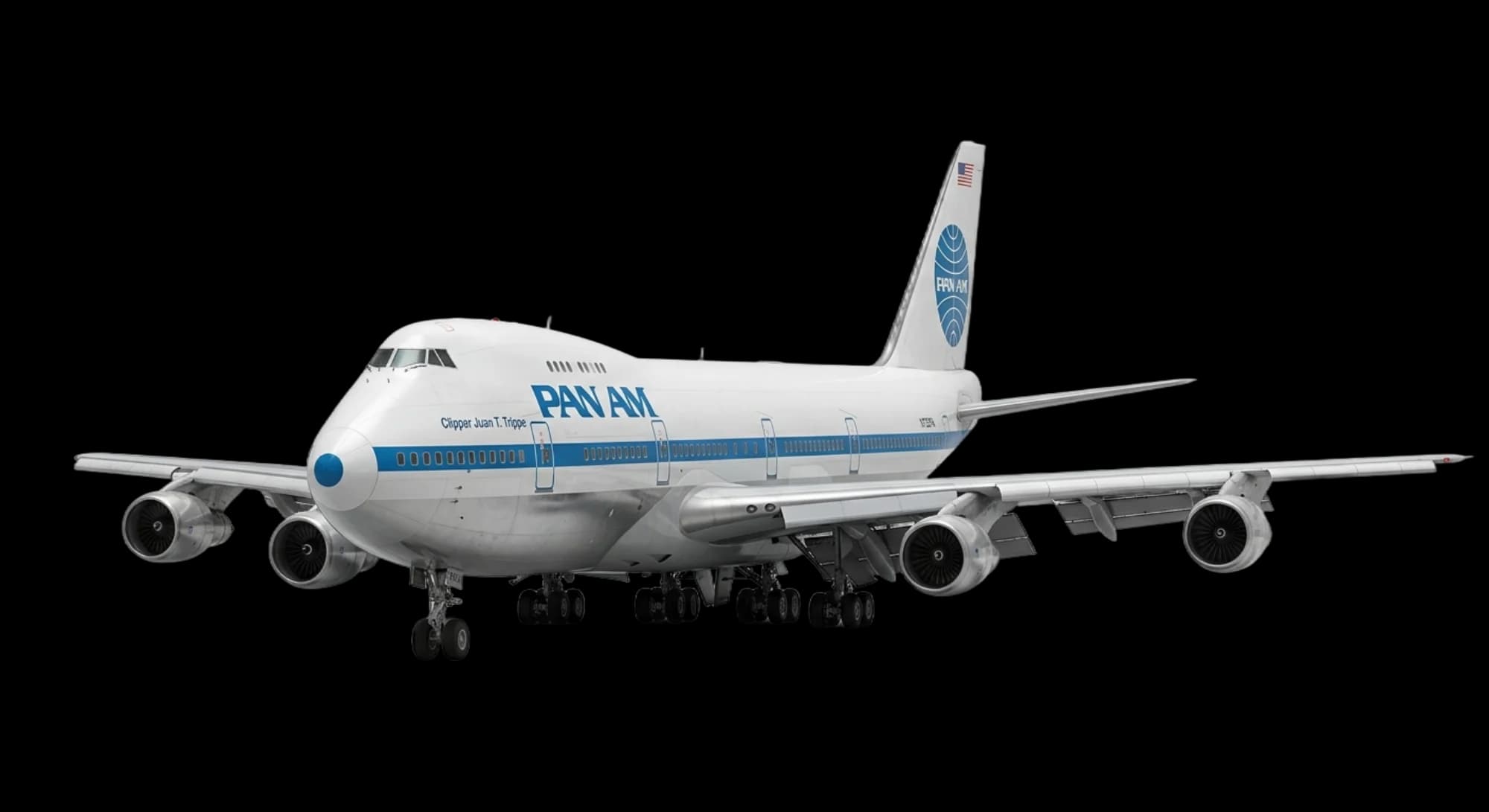
The 747 might never have existed without Juan Trippe, the imperious chairman of Pan American World Airways. Trippe believed that the future of air travel lay in volume. He wanted an aircraft that could carry twice as many passengers as the 707, thereby cutting the per-seat cost dramatically. In 1966, he signed a launch order for 25 aircraft worth $525 million, the largest commercial aviation order in history at that point.
Trippe's insight was fundamentally democratic. He understood that cheaper seats would open air travel to millions of people who had never considered flying. The 747 was not designed for the elite. It was designed to make the elite's mode of transport available to everyone.
Engineering the Icon
The 747's most recognizable feature, its upper deck hump, was born from a practical requirement. Boeing and its airline customers expected that supersonic transports would eventually replace subsonic jets on long routes. To ensure the 747's longevity, the design allowed for easy conversion to an all-cargo configuration. The cockpit was placed above the main deck so that a hinged nose door could open for freight loading. The space behind the cockpit became the iconic upper deck, initially used as a first-class lounge on many airlines.
The aircraft introduced numerous innovations: the first widebody fuselage with twin aisles, high-bypass turbofan engines that were quieter and more fuel-efficient than earlier turbojets, and structural redundancy that made it one of the safest aircraft designs ever produced. The 747's wing, spanning nearly 196 feet, incorporated sophisticated high-lift devices that allowed the heavy aircraft to operate from existing runways.
Democratizing the Sky
The impact was immediate and transformative. Before the 747, a round-trip ticket from New York to London cost roughly $12,000 in today's money. The 747's economics, combined with deregulation in the late 1970s, drove that price down relentlessly. By the 1980s, transatlantic travel was accessible to middle-class families. By the 2000s, budget carriers were offering fares that would have seemed impossible in the pre-747 era.
The ripple effects extended far beyond ticket prices. The 747 made international tourism a mass industry. It enabled global supply chains by carrying enormous belly cargo loads beneath its passenger deck. It connected diasporic communities, allowing immigrants to maintain ties with their countries of origin in ways that previous generations could not. The aircraft reshaped the economies of nations from Thailand to Iceland that became dependent on tourism revenue.
The Freighter That Feeds the World
While the passenger 747 captured public imagination, the freighter variants quietly became the backbone of global air cargo. The 747-400F could carry over 120 tons of freight across intercontinental distances. At any given moment, a significant portion of the world's high-value goods, from electronics to pharmaceuticals to fresh flowers, are in transit aboard 747 freighters. The aircraft made overnight global delivery possible and, in doing so, reshaped manufacturing and retail.
End of an Era
Boeing delivered the last 747, a freighter for Atlas Air, in January 2023. Over 54 years, Boeing built 1,574 examples in passenger, freighter, and special-purpose configurations. The type served as Air Force One, as NASA's Shuttle Carrier Aircraft, and as the platform for the Airborne Laser program.
The 747 was superseded not by the supersonic transports that Boeing once feared, but by efficient twin-engine widebodies like the 787 and Airbus A350. Changing economics favored frequency over capacity on most routes, and the four-engine jumbo could not compete on fuel costs.
But the world the 747 created endures. The expectation that ordinary people can fly anywhere on Earth for a reasonable fare, that fresh produce from Kenya can reach London overnight, that a student from Mumbai can attend university in Michigan, all of this flows from Joe Sutter's improbable machine and Juan Trippe's democratic vision. Few aircraft in history have changed human civilization so profoundly. Arguably, none have.
Written by Singular Heritage Team
Published January 28, 2026 · 5 min read
Part of the Singular Heritage network