The Sound Barrier and Beyond: Humanity's Quest for Speed
For years, engineers believed an invisible wall in the sky would destroy any aircraft that tried to cross it. Then a 24-year-old West Virginia farm boy proved them wrong, and the race to fly faster never stopped.
Introduction
In the autumn of 1947, aeronautical engineers spoke seriously about a "barrier" in the sky. As aircraft approached the speed of sound, roughly 768 mph at sea level, they encountered violent buffeting, loss of control, and sometimes catastrophic structural failure. Several test pilots had died. The British program had been set back by the crash of the de Havilland DH.108 Swallow, which killed Geoffrey de Havilland Jr. in September 1946. Some engineers genuinely believed that sustained supersonic flight might be physically impossible.
The X-1
The Bell X-1, originally designated XS-1, was built specifically to answer the question. Shaped like a .50 caliber bullet, which was known to be stable at supersonic speeds, the X-1 was a rocket-powered research aircraft carried aloft beneath a modified B-29 Superfortress and released at altitude. Its Reaction Motors XLR11 engine, burning ethyl alcohol and liquid oxygen, produced 6,000 pounds of thrust for approximately 2.5 minutes.
The pilot selected for the first supersonic attempt was Captain Charles "Chuck" Yeager, a 24-year-old combat veteran who had shot down 13 German aircraft during the war, including one of the first Me 262 jet fighters destroyed by an American pilot. Yeager had no engineering degree. He had not attended college. What he possessed was extraordinary natural ability, absolute fearlessness, and the calm judgment to fly an experimental aircraft into an unknown regime.
On October 14, 1947, Yeager climbed into the X-1, which he had named Glamorous Glennis after his wife, despite having broken two ribs in a horse-riding accident two nights earlier. He had told only his colleague Jack Ridley, who fashioned a section of broomstick into a lever so Yeager could close the cockpit door with his left hand while protecting his injured right side.
At 43,000 feet, Yeager ignited the last two of the X-1's four rocket chambers. The Mach meter climbed past 0.92, through 0.96, and then jumped to 1.06. There was no explosion, no barrier. The ride, Yeager reported, was "as smooth as a baby's bottom." The sonic boom rolled across the Mojave Desert below, the first ever generated by a crewed aircraft.
The Physics of Speed
The so-called sound barrier was never a physical wall. It was an aerodynamic transition zone where the behavior of air flowing over an aircraft changed fundamentally. Below the speed of sound, pressure disturbances propagate ahead of the aircraft, allowing the air to "prepare" for its arrival. At the speed of sound, these disturbances pile up into shock waves that create enormous drag, alter the pressure distribution over the wings and control surfaces, and can cause severe buffeting or loss of control.
The solution lay in aircraft design: thin, swept wings, all-moving tail surfaces instead of conventional hinged elevators, and area-ruled fuselages that managed the distribution of cross-sectional area along the aircraft's length. These principles, worked out through wind tunnel testing and the X-plane program throughout the late 1940s and 1950s, made supersonic flight routine for military aircraft within a decade of Yeager's flight.
The X-15: To the Edge of Space
The X-15 program, which ran from 1959 to 1968, pushed the boundaries of speed and altitude far beyond the sound barrier. Three X-15s were built by North American Aviation, and they flew 199 research missions from Edwards Air Force Base, using a B-52 as a launch aircraft.
On October 3, 1967, Major William "Pete" Knight flew the X-15 to a speed of Mach 6.7, or 4,520 mph. This remains the fastest speed ever achieved by a crewed, powered aircraft (the SR-71's record is for sustained flight; the X-15 was a brief rocket-powered dash). On August 22, 1963, NASA pilot Joseph Walker reached an altitude of 354,200 feet, or 67 miles, well above the internationally recognized boundary of space at 62 miles.
The X-15 program contributed directly to the development of the Mercury, Gemini, and Apollo spacecraft. Its pilots dealt with reentry heating, reaction control thrusters for flight outside the atmosphere, and the physiological effects of extreme speed and altitude. It was, in many ways, the bridge between aviation and spaceflight.
Concorde: Supersonic for the People
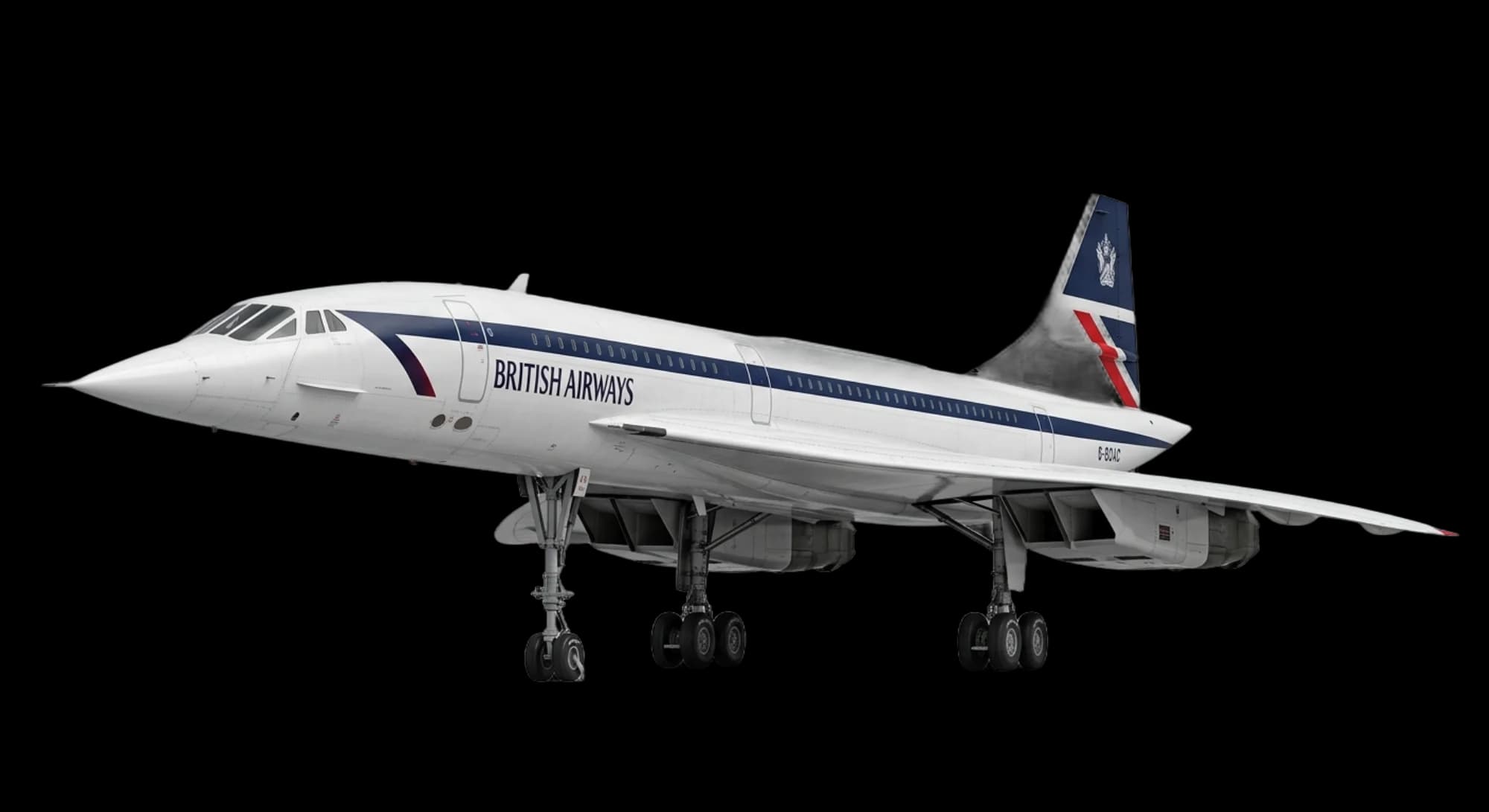
While military aircraft routinely exceeded the speed of sound, commercial supersonic flight proved far more challenging. The Concorde, developed jointly by the British Aircraft Corporation and Aerospatiale of France, first flew on March 2, 1969, and entered commercial service on January 21, 1976.
Concorde cruised at Mach 2.04, or approximately 1,354 mph, at an altitude of 60,000 feet. It could cross the Atlantic in under 3.5 hours, departing London at 10:30 a.m. and arriving in New York at 9:30 a.m. local time, effectively arriving before it left. The engineering achievement was extraordinary: the aircraft's nose drooped for takeoff and landing visibility, its fuel was pumped between tanks to manage the center of gravity as it accelerated and decelerated, and its airframe stretched by nearly 10 inches during supersonic cruise due to thermal expansion.
But Concorde was commercially marginal from the start. Only 20 were built, serving exclusively British Airways and Air France. The sonic boom restricted supersonic flight to overwater routes. Fuel consumption was enormous. Ticket prices were stratospheric. The aircraft served a wealthy niche rather than the mass market.
The fatal crash of Air France Flight 4590 on July 25, 2000, which killed 113 people when a burst tire caused a fuel tank fire during takeoff, began the end. Both airlines retired their Concordes in 2003, citing declining passenger numbers and rising maintenance costs.
The Speed Record Timeline
The progression tells its own story:
- 1947: Chuck Yeager, Bell X-1: Mach 1.06 (700 mph)
- 1953: Yeager again, X-1A: Mach 2.44 (1,650 mph)
- 1956: Captain Milburn Apt, X-2: Mach 3.2 (2,094 mph). Apt was killed when the aircraft tumbled out of control after reaching peak speed.
- 1961: Major Robert White, X-15: Mach 4.62 (3,074 mph)
- 1967: Major Pete Knight, X-15: Mach 6.7 (4,520 mph)
From Mach 1 to Mach 6.7 in twenty years. The pace of acceleration was itself accelerating.
What Comes Next
The quest for speed has not ended. NASA's X-59 QueSST, designed by Lockheed Martin, aims to demonstrate "low-boom" supersonic flight that could lift the regulatory ban on overland supersonic travel. Companies like Boom Supersonic are developing commercial supersonic aircraft for the 2030s. Hypersonic weapons programs in the United States, China, and Russia are pushing toward Mach 10 and beyond.
But the fundamental achievement happened on a clear October morning in 1947, when a young pilot with broken ribs and a broomstick handle proved that the barrier was not a wall. It was a door.
Written by Singular Heritage Team
Published February 7, 2026 · 6 min read
Part of the Singular Heritage network