The Battle of Britain: When the Spitfire Saved a Nation
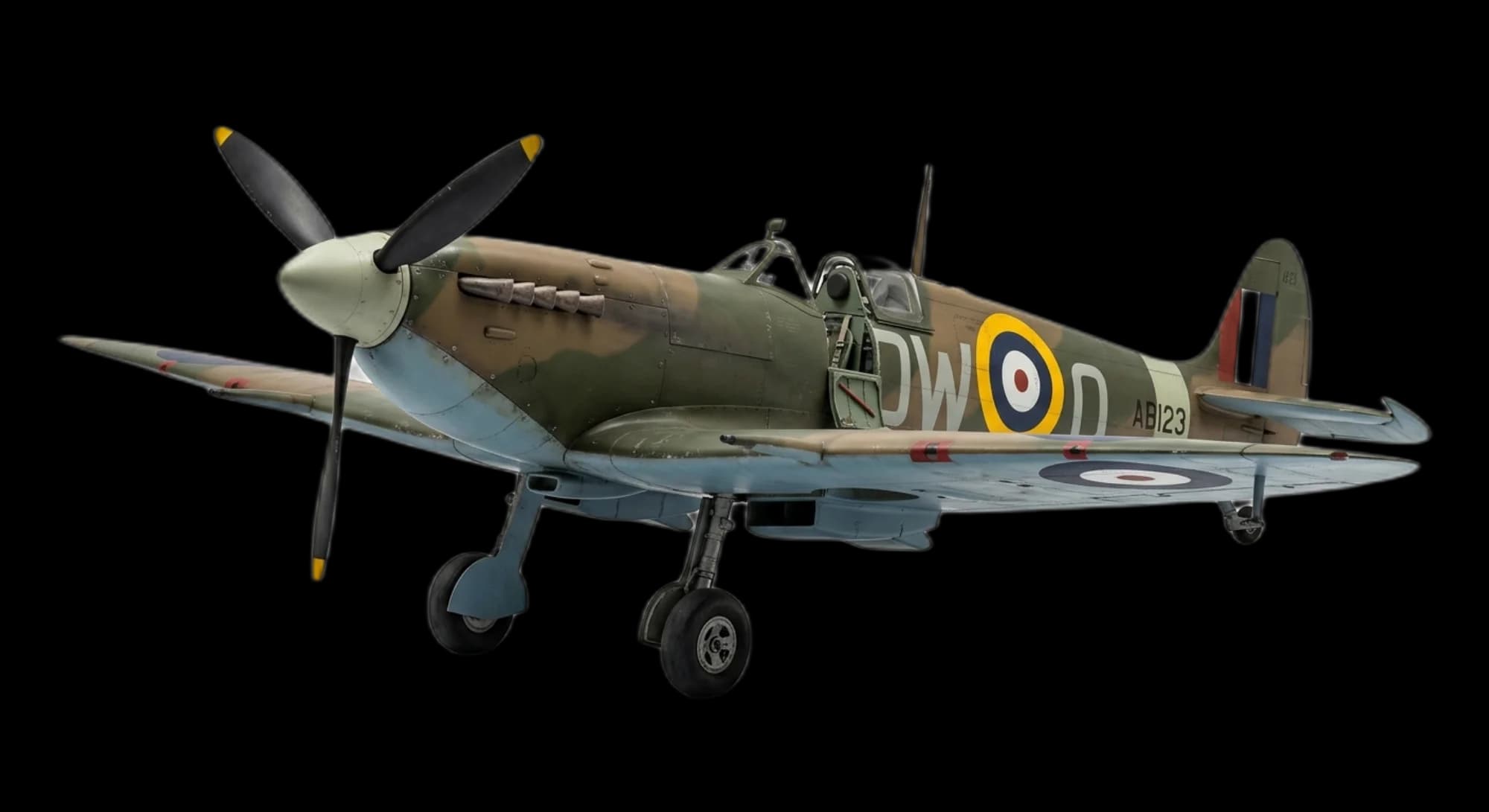
In the summer of 1940, a slender, elliptical-winged fighter became the symbol of British defiance. The Supermarine Spitfire did not win the Battle of Britain alone, but it became the aircraft that defined a nation's will to survive.
Introduction
In the summer of 1940, the fate of Western civilization hung on the performance of a few hundred single-engine fighters and the young men who flew them. The Battle of Britain, fought between July and October of that year, was the first major military campaign waged entirely in the air. At its center stood the Supermarine Spitfire, an aircraft that became far more than a weapon. It became a symbol.
R.J. Mitchell's Masterpiece
The Spitfire owes its existence to Reginald Joseph Mitchell, chief designer at Supermarine, a company better known for building racing seaplanes. Mitchell had won the Schneider Trophy three times with his S.6B design, and the lessons he learned from high-speed flight fed directly into the Spitfire. The distinctive elliptical wing was not chosen for aesthetics. It was an engineering solution to a specific problem: distributing lift evenly across the span to reduce drag while still housing the retractable undercarriage and eight Browning .303 machine guns.
Mitchell first flew the prototype, K5054, on March 5, 1936. He would not live to see his creation in combat. Diagnosed with cancer, he continued working until his death in June 1937, aged just 42. The aircraft that emerged from his drawing board would go on to serve in every theatre of the Second World War and remain in production, in various marks, until 1948.
The Summer of 1940
When Germany launched its air offensive against Britain, the Luftwaffe fielded approximately 2,600 aircraft, including the formidable Messerschmitt Bf 109. RAF Fighter Command could muster roughly 700 operational fighters, split between Spitfires and the more numerous Hawker Hurricanes. The popular narrative credits the Spitfire with saving Britain. The reality is more nuanced.
The Hurricane actually shot down more enemy aircraft during the battle. It was available in greater numbers, was easier to repair, and proved devastatingly effective against bomber formations. Air Chief Marshal Hugh Dowding's tactical approach typically sent Hurricanes against the bombers while Spitfires engaged the Bf 109 escorts at higher altitude. This division of labour played to each aircraft's strengths.
But the Spitfire was the aircraft the Bf 109 pilots feared. In a turning fight, the Spitfire's elliptical wing gave it an edge. The two aircraft were remarkably well-matched in speed and climb rate, but the Spitfire could out-turn the Messerschmitt, and at the altitudes where the battle was fought, that advantage mattered.
The Numbers
Between July 10 and October 31, 1940, the RAF lost 1,023 fighters. The Luftwaffe lost 1,887 aircraft of all types. Some 544 RAF pilots and aircrew were killed, alongside 2,698 Luftwaffe crew. These bare figures conceal the extraordinary attrition rate. At the battle's peak in late August and early September, Fighter Command was losing pilots faster than it could train replacements. The system came perilously close to collapse.
The turning point came on September 15, now commemorated as Battle of Britain Day, when the Luftwaffe launched two massive raids on London. The RAF intercepted both, shooting down 56 German aircraft (the British initially claimed 185). Two days later, Hitler postponed Operation Sea Lion, the planned invasion of Britain, indefinitely.
Myth and Machine
The Spitfire's place in British culture transcends its combat record. During the war, the "Spitfire Fund" encouraged civilians to donate money to build new aircraft. Towns, factories, and individuals contributed, with the cost of a single Spitfire quoted at 5,000 pounds. The aircraft became a vehicle for civilian participation in the war effort, a tangible connection between the home front and the air battle overhead.
This mythology has sometimes obscured the contributions of the Hurricane, the ground crews who kept aircraft flying, the radar operators of the Chain Home network, and the plotting rooms where the battle was coordinated. The Battle of Britain was won by a system, not a single aircraft.
Yet the Spitfire remains, and rightly so, the most celebrated fighter of the war. Mitchell's design was so fundamentally sound that it absorbed engine upgrades, armament changes, and role modifications across more than 20,000 airframes built in 24 distinct marks. From the Mk I that fought in 1940 to the Mk 24 that served into the 1950s, the basic airframe proved adaptable beyond anything its creator could have imagined.
Legacy
Today, around 70 Spitfires remain airworthy worldwide. The sound of a Merlin engine at an airshow still draws crowds to silence. The aircraft speaks to something beyond aviation: to a moment when technology, courage, and national determination converged in a way that altered the course of history.
R.J. Mitchell never saw any of it. But the aircraft he designed in the mid-1930s, drawing on racing seaplane experience and an instinct for aerodynamic purity, proved equal to a challenge no one had foreseen. That is perhaps the Spitfire's greatest legacy. It was built for a war that had not yet begun, and it was ready when that war arrived.
Written by Singular Heritage Team
Published February 2, 2026 · 6 min read
Part of the Singular Heritage network