Blackbird: The Untouchable SR-71
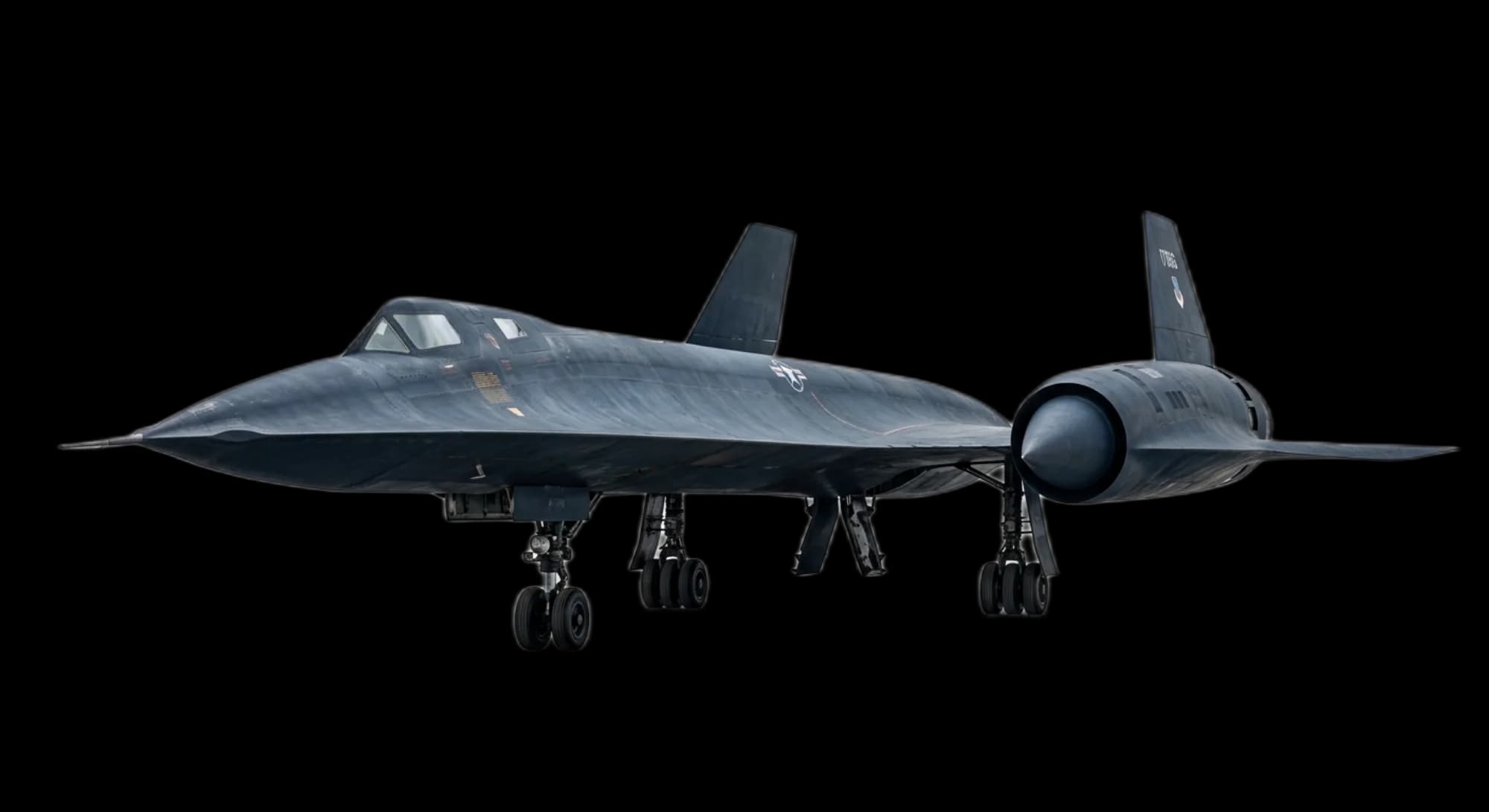
For 34 years, the SR-71 Blackbird flew higher and faster than any adversary could reach. Built from titanium secretly sourced from the Soviet Union, it remains the fastest air-breathing crewed aircraft ever to enter operational service.
Introduction
On December 22, 1964, test pilot Robert Gilliland opened the throttles of an aircraft so secret that its very existence was classified. The SR-71 Blackbird, serial number 61-7950, roared down the runway at Air Force Plant 42 in Palmdale, California, and climbed into the desert sky. It would not slow down for three decades.
Kelly Johnson's Impossible Machine
The SR-71 was the product of Lockheed's Skunk Works, the legendary advanced development division led by Clarence "Kelly" Johnson. Johnson had already created the U-2 spyplane, which CIA pilot Francis Gary Powers was flying when he was shot down over the Soviet Union on May 1, 1960. The U-2 incident humiliated the Eisenhower administration and proved that altitude alone could no longer protect a reconnaissance aircraft. Johnson's response was to add speed.
The A-12, the SR-71's single-seat predecessor built for the CIA under Project Oxcart, first flew in April 1962. The SR-71, a larger two-seat variant for the Air Force, followed in 1964. Both were designed around a simple but audacious concept: fly so high and so fast that no missile or interceptor could catch you.
The performance targets were extraordinary. The aircraft needed to sustain Mach 3.2 (approximately 2,200 mph) at altitudes above 80,000 feet for extended periods. At these speeds, the leading edges of the aircraft would heat to over 600 degrees Fahrenheit. No conventional aluminum airframe could survive those temperatures.
The Titanium Problem
Johnson's solution was to build the aircraft primarily from titanium, a metal that maintained its strength at high temperatures but was notoriously difficult to work with. Titanium was brittle, it corroded when exposed to certain chemicals, and the machining techniques of the early 1960s were barely adequate for the task. Early production suffered rejection rates above 80 percent on some components.
The most remarkable aspect of the SR-71's construction was the source of its titanium. The world's largest supplier was the Soviet Union. Through a series of front companies and third-party intermediaries, the CIA procured Soviet titanium to build an aircraft whose primary mission was spying on the Soviet Union. The Soviets never knew.
Flying at the Edge
Operating the SR-71 was unlike flying any other aircraft. The crew of two, a pilot and a Reconnaissance Systems Officer, wore full-pressure suits identical to those used by astronauts. The cockpit was pressurized to the equivalent of 26,000 feet even at operating altitude. If the pressure suit failed at 80,000 feet, the crew member's blood would boil in seconds.
The Pratt & Whitney J58 engines were a hybrid design, functioning as conventional turbojets at lower speeds and transitioning to ramjet operation at high Mach numbers. At cruise speed, approximately 80 percent of the thrust came from the ramjet effect of the engine inlet system rather than the turbojet core. The engines consumed fuel at a rate of 44,000 pounds per hour, requiring the aircraft to refuel from KC-135Q tankers shortly after takeoff and at intervals during long missions.
The aircraft leaked fuel prodigiously while on the ground. The titanium skin panels were designed with loose fits to allow for thermal expansion at speed. When the airframe heated during Mach 3 cruise, the panels expanded and sealed tight. On the ground, JP-7 fuel seeped from every seam.
Never Intercepted
In its operational career from 1966 to 1990, the SR-71 flew missions over and near the territory of every major adversary, including North Vietnam, North Korea, the Soviet Union, China, Cuba, and Libya. Over 4,000 missiles were fired at SR-71s during this period. Not a single one hit its target.
The aircraft's defense was straightforward. When a surface-to-air missile launch was detected, the pilot simply accelerated. At Mach 3.2, the SR-71 was outrunning the missiles. The standard evasive procedure was to push the throttles forward and let physics do the rest. Major Brian Shul, who flew the SR-71 over Libya in 1986 during Operation El Dorado Canyon, described watching missile contrails arc up and fall behind his aircraft.
No SR-71 was ever lost to enemy action. Twelve of the 32 aircraft built were lost to accidents, all related to mechanical failures or operational incidents rather than hostile fire.
The Records Stand
On July 28, 1976, SR-71 serial 61-7962, flown by Captain Eldon Joersz and Major George Morgan, set the absolute speed record for an air-breathing crewed aircraft at 2,193.2 mph (Mach 3.32). This record remains unbroken nearly fifty years later.
The altitude record, set the same day by Captain Robert Helt and Major Larry Elliott, stands at 85,069 feet. On its final flight to the Smithsonian on March 6, 1990, an SR-71 flew from Los Angeles to Washington, D.C. in 1 hour, 4 minutes, and 20 seconds, setting a coast-to-coast speed record that also still stands.
Retirement and Legacy
The SR-71 was retired in 1990, briefly reactivated in 1995, and permanently retired in 1998. Its reconnaissance role was assumed by satellites and, later, unmanned aircraft. The official reason for retirement was cost: each flight hour required extensive maintenance and specialized logistics.
But the Blackbird's legacy transcends its operational record. It proved that an aircraft could be designed to operate at the very edge of aerospace engineering, in a regime where the sky turns dark blue and the curvature of the Earth is visible, and do so reliably for decades. Kelly Johnson's team achieved this with slide rules and drafting tables, without computer-aided design or modern simulation tools.
The SR-71 remains the high-water mark of crewed aviation performance. Nothing has flown faster in sustained flight. Nothing may ever need to.
Written by Singular Heritage Team
Published February 12, 2026 · 7 min read
Part of the Singular Heritage network